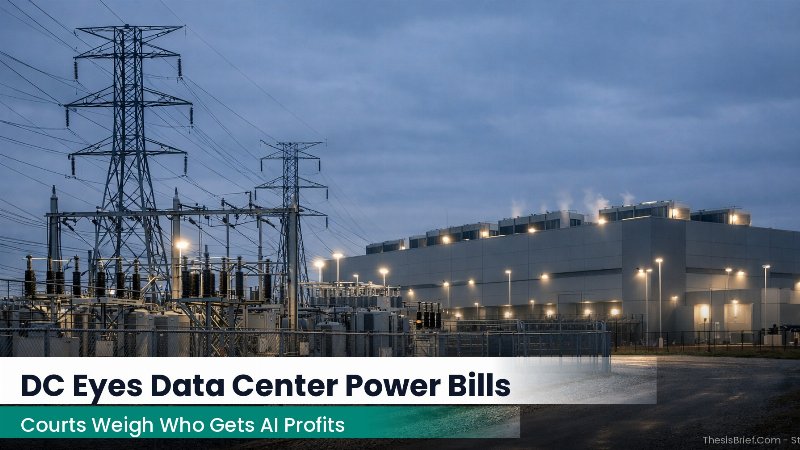
Elon Musk asked a US court to award up to $134 billion from OpenAI and Microsoft, Reuters reported. Data center electricity demand is colliding with grid capacity, forcing long duration contracting tied to regulatory approvals.
AI leaders face a two-front squeeze as Washington targets data-center power costs while courts weigh who owns AI windfalls
Before the latest filings and White House pressure, Big Tech expanded AI buildouts with limited federal constraints on power contracting. Regulators shift grid buildout risk away from households via long duration commitments and minimum pay obligations. PJM now faces a proposed emergency auction offering 15 year contracts for large data center loads. Musk now seeks up to $134 billion in alleged wrongful gains from OpenAI and Microsoft.
PJM is reviewing White House principles after a board decision on integrating large loads. The proposed auction could support about $15 billion in new power capacity construction. OpenAI and Microsoft challenged Musk’s damages model and asked a judge to limit expert testimony. A judge ruled a jury will hear the case, with trial expected to start in April. Ari Peskoe called the consumer protection intent workable, per Business Insider.
Policy actions on electricity procurement and litigation over AI value both constrain scaling and returns. Virginia’s GS 5 class approved in November 2025 shows minimum pay obligations for loads above 25 MW. A 15 year PJM contract would hard code pay for power, while a jury trial can reprice gains. Peskoe warned these markets are complicated, while PJM must translate principles into auction terms. OpenAI’s and Microsoft’s expert challenge turns damages math into a gatekeeping proceeding.
Data centers require incremental generation, new substations, and transmission upgrades, while regulators push cost shielding mechanisms. The GS 5 structure requires minimum payments for unused capacity, while the PJM concept requires pay for power commitments. Musk’s filing frames $65.5 billion to $109.4 billion for OpenAI and $13.3 billion to $25.1 billion for Microsoft. Courts can limit what jurors hear from an expert, while policymakers press for affordability constraints on procurement. Microsoft’s compute buildout remains tethered to power market design and remedies like injunctions.
Whether PJM will implement the emergency auction stays unclear. Which hyperscalers would bid, and at what price levels, remains undisclosed. The White House directive cannot be framed as reducing electricity prices from the current record. Allegations of wrongdoing by OpenAI or Microsoft remain unresolved in court filings. The shift forces higher fixed cost scaling while litigation clouds who captures windfalls. How admissibility rulings and pay for power commitments evolve will determine scaling flexibility and ownership of AI returns.