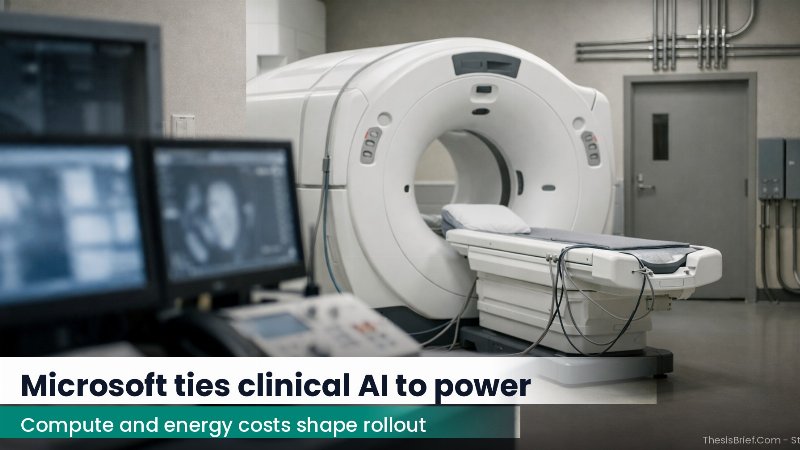
Bristol Myers Squibb partnered with Microsoft on radiology AI for lung cancer detection, Reuters reported. AI workloads are colliding with electricity and silicon costs, forcing deployment choices to follow compute economics.
Microsoft is pairing real clinical AI deployments with a public push that energy and compute costs will govern AI adoption.
Before this cycle, AI adoption narratives centered on model capability and corporate spending on data centers. When power needs become binding, hyperscalers lock long term supply agreements to keep capacity available. Bristol Myers signed an agreement with the company to use an AI enabled radiology platform. The collaboration uses FDA cleared radiology algorithms through Microsoft’s Precision Imaging Network.
Nadella said energy costs will be key to deciding which country wins the AI race. Bristol Myers said the tools can help clinicians identify hard to detect lung nodules earlier. Bristol Myers said a key aim is expanding early detection access in underserved US communities. Europe has faced higher energy costs since Russia’s invasion of Ukraine and sanctions, per CNBC. "Clinicians can more easily identify patients who may be showing early signs of cancer often before they are aware of any symptoms", said Peter Durlach, Corporate Vice President and Chief Strategy Officer, Microsoft Health and Life Sciences at Microsoft, according to Bristol Myers Squibb.
The healthcare partnership puts AI into regulated imaging workflows while token purchases define compute as a priced unit. Microsoft’s Precision Imaging Network scales distribution while Nadella frames energy as the scarce input. Constellation announced a 20 year PPA to sell output to Microsoft while Three Mile Island Unit 1 restarts hinge on NRC approval. That restart is expected in 2028 while this lung imaging rollout has no disclosed hospital timeline. Microsoft previously guided to $80 billion for AI data centers with about half outside the US while energy cost differences stay central.
Wedbush analyst Dan Ives warned policy pressure to make Big Tech cover data center electricity costs could constrain buildouts, with fast footprint targets. High stakes clinical imaging offers outcome language while the buildout debate centers on who pays for power. Tokens describe consumption while hospital imaging volumes define when those token factories show measurable use. Pharmaceutical firms have used AI across pipelines while clinical deployment raises scrutiny on outcome measurement. The strategic value sits in regulated workflows while operating costs define where scaling can occur.
Which hospital systems deploy the Bristol Myers and Microsoft workflow first remains unspecified. Commercial terms, pricing, or revenue sharing for the partnership stay undisclosed. Missing clinical metrics constrain any claim about survival, mortality, or validated stage shift. Undisclosed deal economics add a hard boundary on revenue impact for both firms. Microsoft can use outcome oriented clinical workflows as proof points to justify energy and compute footprints over 6 to 18 months. How quickly hospitals adopt Precision Imaging Network tools and whether electricity and silicon costs tighten remain open variables shaping the token factory narrative.