Nvidia CEO Jensen Huang urged more AI investment at Davos, The Wall Street Journal reported Wednesday. AI spending is colliding with energy supply and infrastructure, forcing power procurement and buildout pacing constraints.
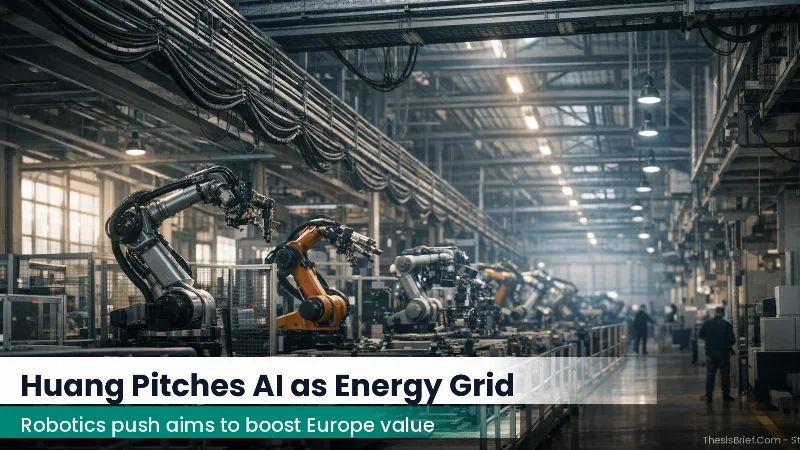
Huang is reframing AI spending as an energy and infrastructure problem, using robotics to argue Europe can capture value beyond software
AI investment debates focused on chip supply, cloud capacity, and whether spending signaled a bubble. AI leaders treated scaling as procurement, where long term electricity supply underwrites data center expansion. European industrial firms such as Siemens, Mercedes-Benz Group, Volvo, and Schaeffler announced robotics projects and partnerships. Robotics companies raised $26.5 billion in 2025, according to Dealroom.
Huang said AI infrastructure buildout has already reached a few hundred billion dollars. He said the buildout could require trillions more in infrastructure. He described AI as a five layer stack including energy, chips, cloud infrastructure, models, and applications. He said application is the layer where economic benefits accrue. "AI is infrastructure" said Jensen Huang, President and CEO at NVIDIA, according to NVIDIA Blog.
The remarks shift the AI debate from model capability and valuations toward energy supply and infrastructure, while procurement becomes prerequisite. Microsoft and Constellation Energy announced a 20 year power agreement tied to restarting Three Mile Island Unit 1. Constellation targeted 2028 and cited U.S. NRC approvals plus permits, with about $1.6 billion restoration costs. That precedent shows where AI expansion can fail when regulatory approvals and capital budgets lag. A WEF op ed by Kearney partners argued Europe can still win by prioritizing physical AI, as argued by World Economic Forum.
Huang said Europe must increase energy supply to enable AI infrastructure and ecosystems, while robotics becomes the application wedge. Nadella said energy costs will be a key factor in national AI success, as spending debates persist. European robotics projects sit inside manufacturing incumbents, while interoperability and collaboration remain the Kearney bottleneck. Huang framed AI robotics as a Europe opportunity tied to its manufacturing base, while value capture sits downstream. Nvidia stays central to AI compute, while the competitive framing shifts toward energy capacity and industrial adoption.
Specific investment amounts or timelines Nvidia wants commitments on remain unspecified. Whether European governments or companies pledged new energy or data center projects stays unclear. Cannot claim Europe will overtake the US in AI leadership based on these remarks alone. Cannot quantify required energy expansion without figures in the sources. The short term framing shifts the battlefield to policy and capital allocation in generation, grids, and industrial digitization. How Europe scales energy supply and whether interoperability improves will determine robotics adoption and downstream value capture.