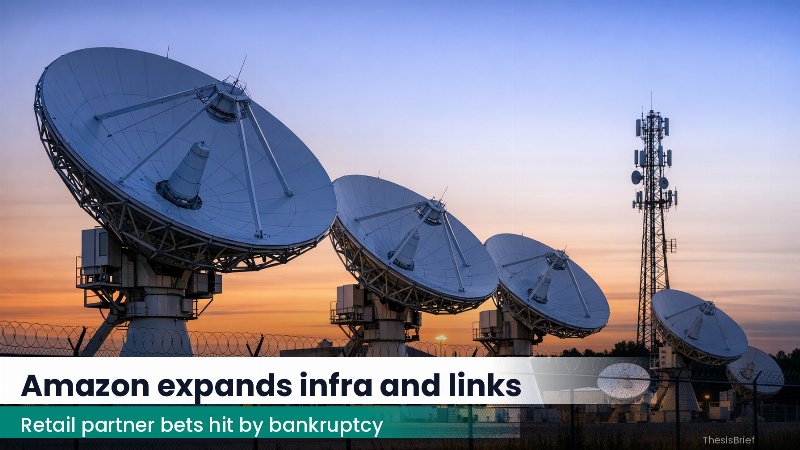
Nigeria granted Amazon’s Kuiper Systems a seven-year Ka-band broadband permit, Reuters reported. Connectivity buildout is colliding with regulatory schedules, forcing market entry to track licensing windows.
Amazon is pushing expansion in infrastructure and connectivity, but partner-dependent bets in retail still carry fragility exposed by bankruptcy fallout.
Before the Nigeria permit and the Saks filing, Amazon pursued luxury collaborations while building Project Kuiper amid competition. In luxury retail, partner-dependent digital transformation bets can unravel when a partner’s finances deteriorate. Saks and Amazon partnered in December 2024 linked to Saks’ acquisition of Neiman Marcus. Nigeria is Africa’s largest telecoms market and is opening to next-generation satellite systems.
SpaceX is among operators cleared to expand space-based broadband in Nigeria. The Nigerian permit covers service from February 2026 to February 2033 for Ka-band. According to The Dallas Morning News, Neiman Marcus Group ended its Farfetch partnership on Feb. 7, 2024, illustrating how re-platforming can falter amid financial turmoil. Financial Times described Saks’ bankruptcy as a debt and cash flow spiral that triggered supplier withholding. "That equity investment is now presumptively worthless after Saks continuously failed to meet its budgets, burned through hundreds of millions of dollars in less than a year, and ran up additional hundreds of millions of dollars in unpaid invoices owed to its retail partners," said Amazon.com Inc. (court filing), Objection to Saks Global’s debtor-in-possession financing (court filing) at Amazon, according to Retail Dive.
Regulatory clearance advances Kuiper expansion while the Saks bankruptcy highlights vulnerability in partnership-led retail moves. Kuiper plans a 3,236-satellite network as Nigeria’s NCC licenses Ka-band through February 2033. Saks Global filed for bankruptcy protection as Amazon sought to block Saks access to restructuring financing. Amazon invested $475 million tied to Saks merchandise being sold on Amazon, according to a court filing. Kuiper’s Nigeria permit is an Amazon-controlled option, while Saks is a court-controlled process.
Nigeria’s licensing framework aims to draw investment as Kuiper’s entry still depends on regulators. Financial Times’ supplier-withholding dynamic frames how counterparties can shrink assortment during a restructuring shock. Neiman Marcus said it would keep Bergdorf Goodman e-commerce running independently after dropping Farfetch plans. Amazon’s move to block part of debtor-in-possession financing shows how minority positions collide with lender-led terms. The strategic implication is a split between Amazon-controlled connectivity optionality and unsecured-creditor exposure in retail partnerships.
Whether Saks will keep selling merchandise on Amazon during bankruptcy remains unclear. How Amazon’s $475 million investment is treated in court stays undisclosed. Kuiper rollout timing details in Nigeria, including ground infrastructure and service pricing, remain unclear. Whether additional African regulators grant similar permits on similar timelines stays undisclosed. Lack of deployment and subscriber data constrains any conclusion about Kuiper’s commercial success in Nigeria. Bankruptcy outcomes constrain any claim about loss or recovery of the Saks investment. Kuiper’s Nigeria permit expands infrastructure optionality, while the Saks fight may shift future partnership underwriting. How Nigeria’s February 2026 start converts into deployments and whether bankruptcy treatment preserves Amazon’s stake will determine how this dual-track strategy compounds risk.