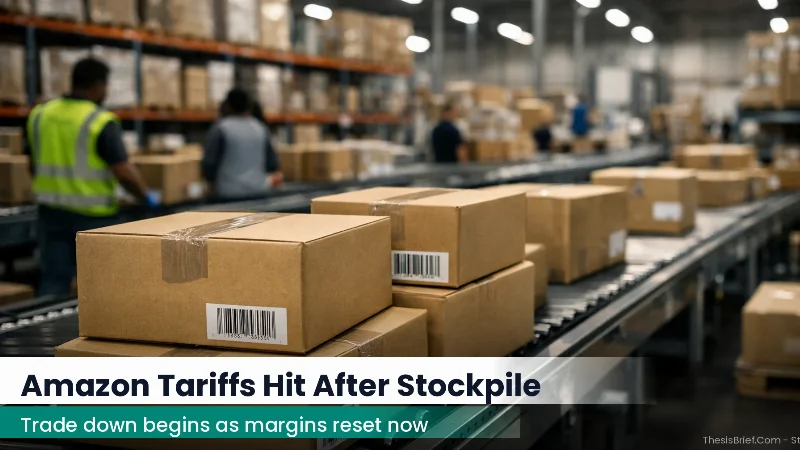
Amazon CEO Andy Jassy said tariffs are starting to push up prices, MarketWatch reported. Tariff pressure is colliding with inventory depletion, forcing delayed pass-through and margin repricing.
Amazon's tariff impact is arriving later than expected because stockpiling delayed price rises, and the new wave is now forcing consumer trade-down while investors reprice retail margins
Before tariff pressure reappeared in prices, retailers and third-party sellers built inventory buffers. Retailers used pull-forward stockpiling to delay pass-through, then faced a price or margin decision. Jassy previously said price impacts had not appeared after earlier tariff announcements. MarketWatch reported retail stocks weakened as tariff fears returned, including declines in Amazon, Walmart, and Target.
Many third-party merchants bulk-ordered inventory in 2025 to get ahead of tariffs, and that supply ran out near late 2025. Some sellers are passing higher costs to consumers, some are absorbing them, and some are doing both. Retail operating margins are mid-single digit, limiting the ability to absorb cost increases. A Kiel Institute policy brief finds about 96% tariff pass-through to US buyers, per Kiel Institute for the World Economy. "(We're starting) to see some of the tariffs creep into some prices. Some sellers are deciding that they're passing on those higher costs to consumers, some are deciding that they'll absorb it to drive demand, and some are doing something in between. So you're starting to see more of that impact," said Andy Jassy, Chief Executive Officer at Amazon, according to Reuters (via Yahoo Finance).
Stockpiled inventory muted tariff pass-through earlier, while depleted supply now forces higher shelf prices. Pull-forward delays price tags, while the later margin hit concentrates into a narrower trading window. Jassy described sellers splitting between pass-through and absorption, while retail margins stay mid-single digit. The Kiel finding implies limited absorption room, while seller choices shift the burden toward buyers. NuScale and UAMPS ended CFPP in 2023, showing how viability can fail when offtake subscriptions thin.
Amazon data show shoppers are switching to cheaper brands, while premium discretionary purchases get delayed. Sellers can hold prices and take a margin hit, while raising prices risks demand loss. MarketWatch tied tariff fears to declines across Amazon, Walmart, and Target, while Costco edged up. Costco said on May 29, 2025 it pulled forward shipments and framed price hikes as a last resort. Strategic implications center on mix shift toward lower-priced items, tightening third-party unit economics and margin scrutiny.
Which specific product categories see the largest tariff-driven increases remains unclear. How much of the cost Amazon versus third-party sellers absorb stays undisclosed. Missing category data constrains any Amazon-wide tariff inflation estimate. No competitive share data limits claims about market share shifts. The strategic horizon is framed as one to three quarters of mix and margin focus. How quickly buffers rebuild, whether promotions rise, and how pass-through interacts with trade-down will determine retail margin repricing.